
Reviving A Lost Feature
Those of us who have been in the industry long enough would recall Legacy Final Cut Pro 7. It was a professional video editing software developed by Apple. Final Cut Pro 7 was highly popular and widely used in the film and television industry for its advanced features and powerful tools. It allowed users to edit and manipulate video footage, audio, and graphics in real-time, making it a favourite among video editors who demanded high-speed and efficient workflows. In 2011, Final Cut Pro 7 was replaced with the highly controversial announcement of Final Cut Pro X; which is simply called Final Cut Pro now.
In that era, editors could export structured film lists from a timeline — cut events, optical effects, transitions, filter effects, and motion effects, together with their position on the timeline — for conforming, collaborating with lab and post teams, or sharing edit information with clients. Once a sequence was prepared for export, the dialog let you choose list format, the video track to base the list on, and which items to include — as PDF for easy reading and printing, or as XML for exchange with other software in the post-production pipeline.
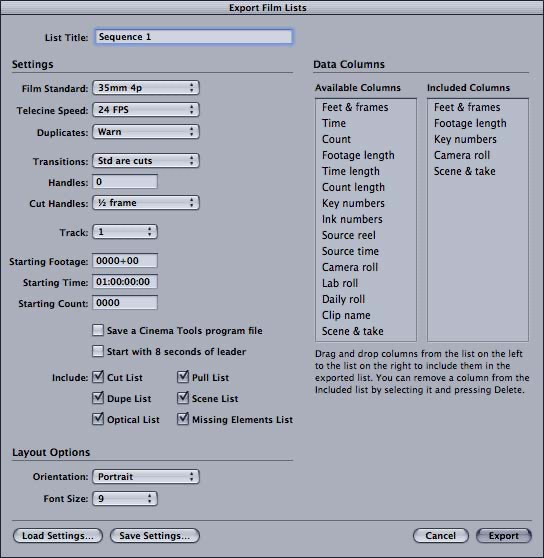
PDF-format lists could be customised with item selection, column order, orientation, and font size, and settings could be saved and loaded across systems. This allowed collaborators to reference specific points in the project and stay organised throughout the editing process.
In Final Cut Pro today, Export XML remains a powerful and widely used feature. Final Cut Pro is extremely capable at handling metadata, and Export XML contains most of the timeline’s information, including roles, markers, keywords, transitions, effects, and more. However, it is not easily accessible from the end user’s perspective as a structured production spreadsheet. FCPXML is the interchange; Excel and PDF are what assistants, producers, and department heads typically need to open, filter, and hand off.
Is it plausible for us to reinvigorate this functionality and modernise it to align with contemporary workflow requirements?